
Getting Your Shop Found on Google
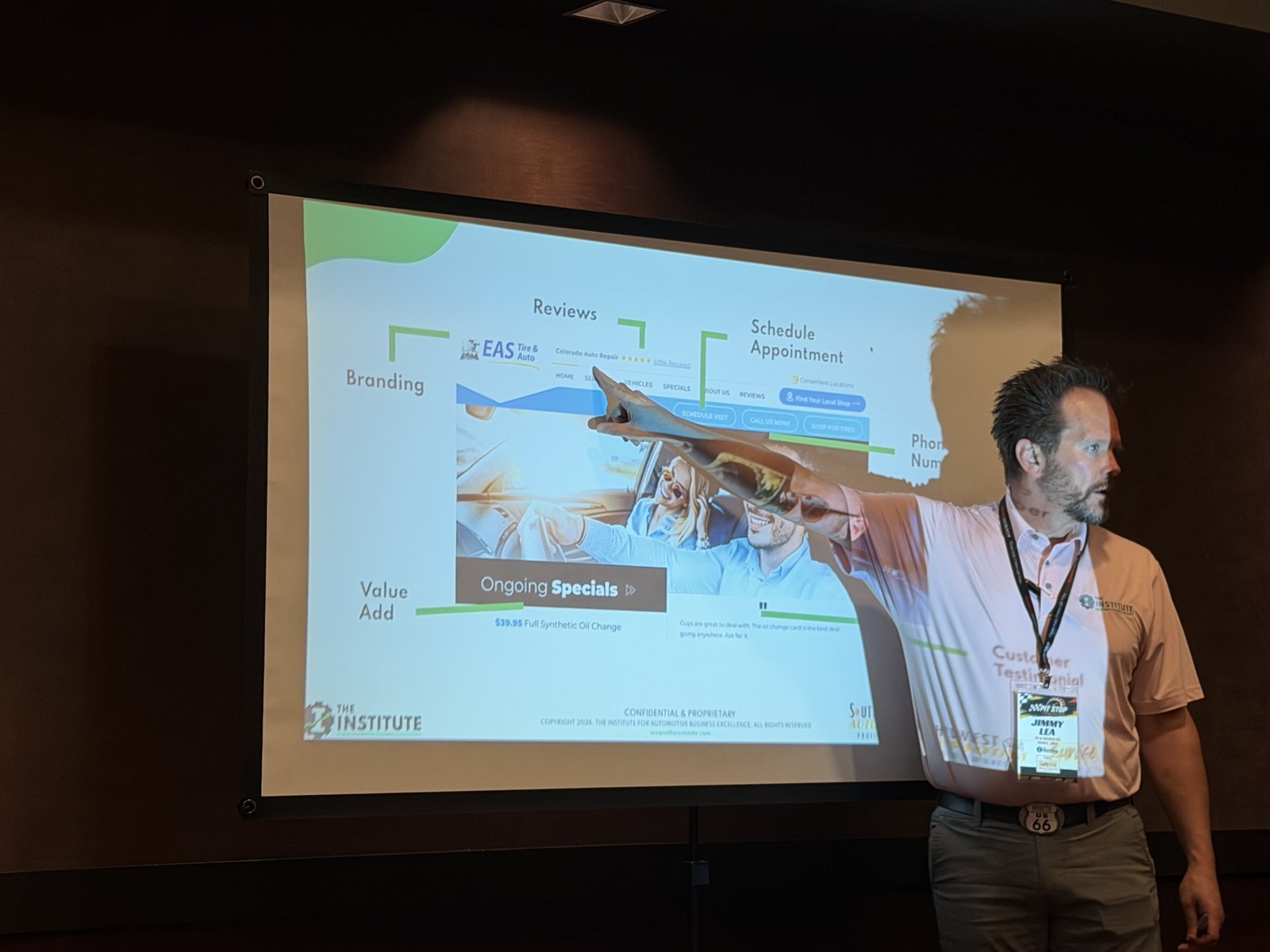
One of the sessions we sat in on at the Sunrise Automotive Training Expo was Jimmy Lea’s class from The Institute on getting your shop found on Google. We’re in media marketing, and we still had a lot to learn from it. You might too. Here’s a recap of what he covered. Credit for all of it goes to Jimmy. We’re just passing along the notes.
In this recap:
- Your website should do the thinking for the visitor
- Watch the numbers Google watches
- Reviews: get real ones, and reply to them
- Real photos and real video
Your website should do the thinking for the visitor
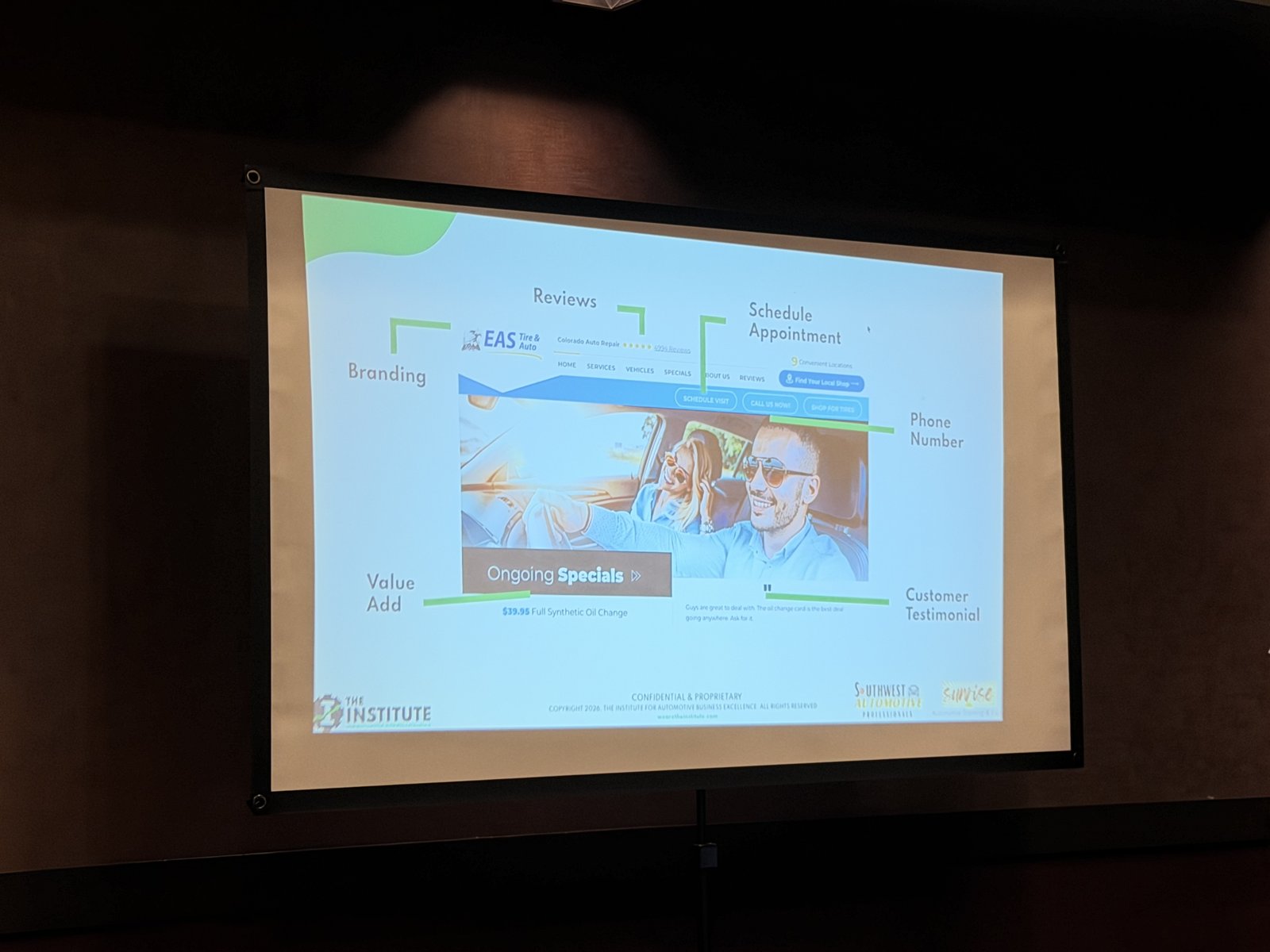
Jimmy’s layouts all came back to one principle: put the most important information, and the actions you want people to take, where they’ll see them without having to think about it.
He pointed out that in the US, people scan a screen left to right and top to bottom, so that’s the order to prioritize in. The things a visitor actually wants, your phone number, your hours, where you are, and a way to book, belong near the top and easy to tap, not buried three scrolls down. And it has to hold up on mobile, which is where most of your visitors are. A layout that looks fine on a desktop can fall apart on a phone.
Watch the numbers Google watches
Jimmy demoed a free page-speed tool that breaks a site down in real detail, things like Largest Contentful Paint and the different measures of how long a page takes to load. As he pointed out, there’s more than one. Load time isn’t a single number.
His point was that Google factors this into how it ranks you, and you don’t need to become a web developer to use it. Knowing these numbers lets you have a real conversation with whoever runs your website about what to keep improving. It turns “the site feels slow” into a specific, fixable list.
Reviews: get real ones, and reply to them
On reviews, Jimmy’s short version was to get real, authentic ones.
It’s tempting to look for shortcuts, but he was clear that Google is good at spotting fishy behavior, and if it decides you’ve crossed a line, cleaning that up is not a walk in the park. Two things he emphasized instead:
Respond to your reviews. All of them. It shows customers you’re paying attention, and it shows Google the same.
Be specific. When you ask for a review, and when you reply to one, detail helps: the job that was done, the kind of car, what the customer came in for. “Thanks for the 5 stars” does nothing. Something like “glad we could get the brakes sorted on your 4Runner before your road trip” is specific, human, and it feeds Google the kind of relevant detail that helps you show up.
Real photos and real video
This was the one Jimmy kept coming back to. He made the case for real media, real photos and real video, everywhere your shop shows up: your Google Business Profile, your reviews, your website, any platform you’re on.
The reason is authenticity. Stock images and generic filler don’t prove anything. Real footage of your shop, your team, and the actual work does. Video especially is one of the realest ways to show people, and Google, that you are who you say you are.
The takeaway
That was Jimmy’s class in a nutshell: a layout that respects your visitor’s time, the numbers Google actually watches, real reviews you actually reply to, and real photos and video everywhere you show up.
If you want a hand with the media side of that, real photos and video that show your shop for what it is, that part is squarely what we do. Reach out here.